

How to Edit - BFI Week 5
Editing may suck, but you still need to do it.

I used to hate editing.
I’d finish a manuscript, sit on my laurels for a bit, then move straight to the next project. But over the last two years, having spent more hours editing drafts than writing new material, I’ve learned to appreciate (and even enjoy) the process.
There's a different kind of beauty to editing; if writing is spring, fruitful and new, then editing is the ice-cold beauty of winter, when things are laid bare and stark.
Editing is the space where you confront issues in your work. It’s where you learn to solve those issues, and where you hone your skills so you can create something even better next time. It’s where you elevate your work, polishing it from the raw material you unearthed in the writing process.
My writing brain and editing brain are becoming two separate ‘modes’ I transition into as needed. It’s a delicate line to walk; the processes require different mindsets, and editing too early in the creation process can kill your motivation.
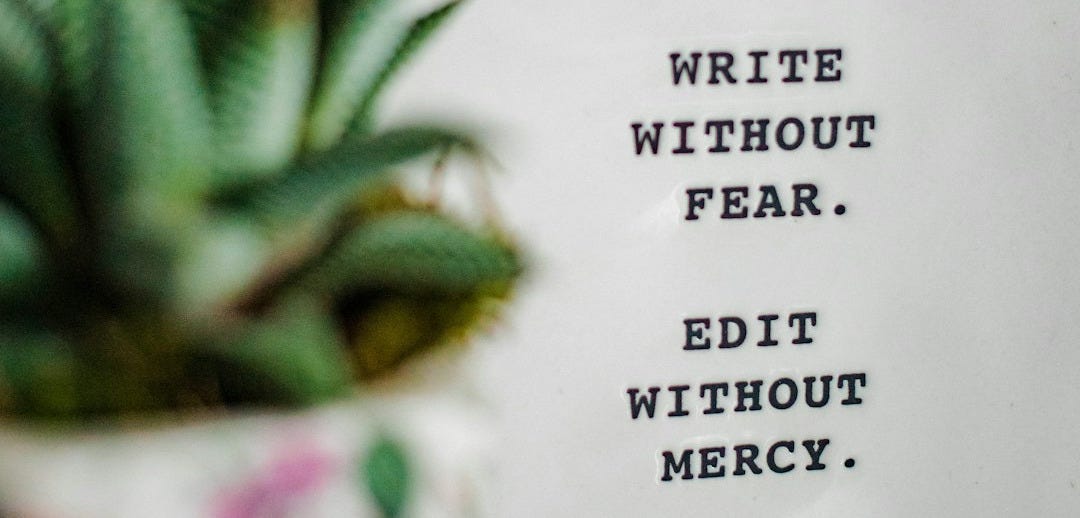
When you write, write without fear. But when you’re ready to edit, edit without mercy.
This is Part Five of my Blueprint for Improvement series. Most of the advice in here is geared towards fiction, but can be adapted for other forms of writing.
Before you begin
Remember that EVERYONE’S first draft needs to be edited. Yours, mine, your favorite author’s. There are huge changes from first to final draft, so don’t feel discouraged if there’s a lot to work on. It doesn’t mean your writing is bad.
Edit like this is someone else’s work. Try to be as objective as possible, and to not become overly attached to anything in particular.
Work with the mindset that you’re raising your piece to its highest potential. Operate from a place of optimism, not defeat.
Be aware that you’ve likely done one of two things: overwritten (including scenes that serve no real function, going on too long in your descriptions, etc.) or underwritten (left out details that are necessary for the plot, not spent enough time developing the characters, etc.). You’ve probably done both, at different points in your manuscript.
Assemble any notes you’ve written about your work, and any feedback you’ve received. Be prepared to consult your editing notes frequently.
Macro-Editing
Macro-level editing always, always, always comes first. This is big picture stuff— plot, pacing, characters. There’s no point in focusing on small details like wording and grammar if you end up cutting sections or adding new ones.
First things first, do a full read-through without stopping to edit. If your work is lengthy, this could take days to weeks. Take notes as you go.
If you haven’t created an outline, now is the time to do so. Analyze each scene and chapter— is it actively advancing the plot or character development? If not, it can probably be cut or reworked.
Look for:
Plot holes and inconsistencies
E.g. Whoops! I said in the first chapter that Gene has a brother, but later on he states that he’s an only child.
Missing scenes
Maybe you sped through the first draft and now Taylor and Anna have progressed too rapidly from strangers to lovers. You could benefit from adding in a few more scenes between the two of them.
Pointless/repetitive scenes
You meant for the first chapter to briefly introduce us to Henry as he gets ready for school, but instead we’re watching Henry brush his teeth, comb his hair, sit on the toilet, take a shower— and he does it all again in chapter three!
Pacing
The pace of a first draft often rushes or drags. Mine often drag in the middle. Make sure each scene is serving a purpose in moving the story or character development along. Make sure there’s tension and rising stakes from start to finish. For a great piece on pacing, check on The Novelry’s how-to guide.
Realistic time progression
E.g. Whoops, I started in spring and wrote about a two-month vacation, but the novel ends in December!
This doesn’t have to be detailed down to the minute, but you should have a loose sense of how much time these plot events require to unfold.
Character Development
Think big picture– do your characters have goals? Are they actively pursuing them? Are they participants in progressing the plot, or just passive observers of events unfolding around them? Are they changing and growing over the course of the novel?
Too slow of a start
Make sure you aren’t starting too far removed from the action. This was my most recent manuscript’s issue. I had too long of a build-up before the plot events actually began. You can often cut more of the beginning material than you think.
Dragging in the middle
The stakes aren’t rising and everyone’s waiting around for the finale to begin. Make sure important plot and sub-plot events are taking place in the middle of your work.
A rushed ending
If you have the ending in mind, you’re often eager to get there. But the ending needs to be paced correctly— we need to be invested, and events should keep progressing naturally until the climax and denouement. Keep an eye out for missing scenes here!
For my last manuscript’s macro-level edits, I had to rewrite the entire second half of the story— 50,000+ words. For my current one, I had to rework the first seven chapters and add a subplot to flesh out the middle section. Be ready to make big changes, if that’s what’s needed. Also, be prepared to “kill your darlings”— cutting content you love but that doesn’t serve a distinct purpose. I originally moved my project’s prologue (which I loved) to be a flashback interlude. Then I realized it didn’t give the readers any information that wasn’t stated in other chapters, and, with a heavy heart, I cut it entirely.
Macro-editing a novel takes months. This is a long term project. Find a method that works for you, and settle into the editing grind.
For a brief guide on macro- (and micro-) level editing for non-fiction, see here.
Micro-Editing
Congratulations! You’ve put in hours of your life macro-editing. You’ve written new scenes, cut some old ones, and tightened up the pacing. Now comes perhaps the most tedious, most stereotypically ‘editor’ aspect of this process— micro-editing.
We’re talking word choice, sentence structure, and proper punctuation. I actually enjoyed my American Grammar class in college, so I find micro-editing satisfying, but I also find it repetitive at times. Sometimes I just want to write, not take a red pen to my work. But this stage has enormous potential for learning— the more effort you put in here, the easier these things will become in subsequent drafts.
Take this process slowly. Go over every scene, every sentence, every word with a fine-toothed comb. Read your writing aloud to get a sense of how the words flow.
If grammar isn’t your forte, I advise taking things one at a time. Read up on how to write dialogue, and focus on that. Then shift to formatting your writing. Then move on to showing, not telling and using active language by cutting adverbs. Buy a book about editing. Practice by editing single paragraphs at a time. If this is unfamiliar territory to you, take it slowly and be kind to yourself. It may take several passes through your work to address every aspect of the micro-edit.
I have a fairly good grasp on standard formatting and grammar, but I’ve taken a lot of classes that have helped teach me what I know. My process for micro-editing a chapter is as follows:
Dialogue
First, I read through all the dialogue (and the tags and actions surrounding it). I read it out loud and try to act it out, testing if it flows naturally. I verify that my characters sound distinct and consistent. I check to make sure I’ve formatted every line of dialogue correctly.
Description
Then I go back to the beginning and read through everything that isn’t dialogue. I check to make sure my descriptions are tight but vivid, and that the action scenes aren’t confusing. I try to color descriptions through the perspective of that chapter’s narrator.
Full Chapter Read-Aloud
Lastly, I read through the chapter from start to finish, speaking each word out loud. I tighten up sentences and paragraphs, and fix any clunky wording I missed in previous pass-throughs.
Micro-edit through your entire work, going through as many rounds as you need! After that, your work should be ready for either more feedback or the publishing process.
Editing may be inseparable from writing, but it’s an entirely distinct process. I hope this week’s information helps you develop your ‘editor brain’ and feel more confident in your ability to improve your work.
As a summary:
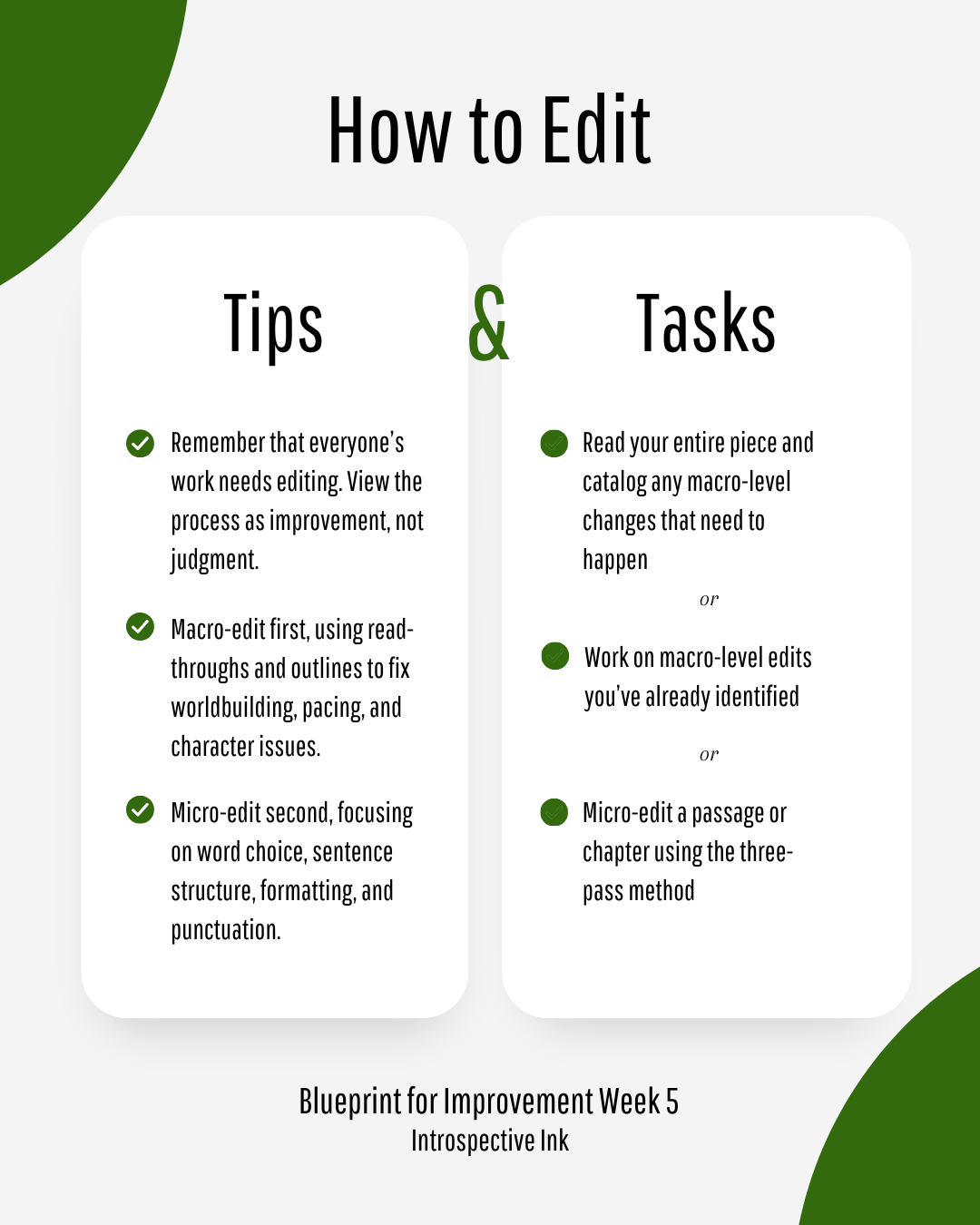
Remember that everyone’s drafts need to be edited. Look at it through the lens of making your work the best it can possibly be.
Start with macro-editing. Read your entire piece and outline it (if you haven’t already). Look for issues like plot holes, missing scenes, pointless scenes, rushed or dragging pacing, and realistic time progressions. Fix those before moving to micro-level edits.
Micro-edit last, focusing on word choice, sentence structures, formatting and punctuation. Try the three-pass method if you aren’t sure how to break down a chapter.
Your choices for this week’s challenge are:
Macro-editing
Read over your entire piece, taking notes about what needs fixing as you go.
Or, if you already know a specific aspect you need to work on, commit to working on that in your edits this week.
Micro-editing
Edit a passage or chapter (or an entire piece, if it’s short) following the three-pass method of dialogue, description, and then a full-chapter read-aloud.
Next week, we’ll talk about the cyclical nature of this process in Rinse and Repeat, the last installment of our Blueprint for Improvement series! It’s hard to believe it’s already drawing to a close. I’ve really enjoyed fleshing out the writing process in this series, and I’d love to hear your thoughts on our penultimate post in the comments below!
Have a great week, and I’ll see you next Sunday!
Allie
Introspective Ink is an entirely reader-supported publication. If you loved what you read and want to support my work, consider becoming a free or paid subscriber. If a monthly subscription isn’t in your budget, consider donating a few dollars through Buy Me a Coffee.

"When you write, write without fear. But when you’re ready to edit, edit without mercy."
Great advice!
So glad I stumbled across this because I've just started to do a first edit of my impossibly huge novel THE SHIELD OF LOCKSLEY. At 253,000 words, it definitely needs whittling down.